“I’m Not Trying to Write Homework”: Scouting For Girls on Keeping Pop Simple
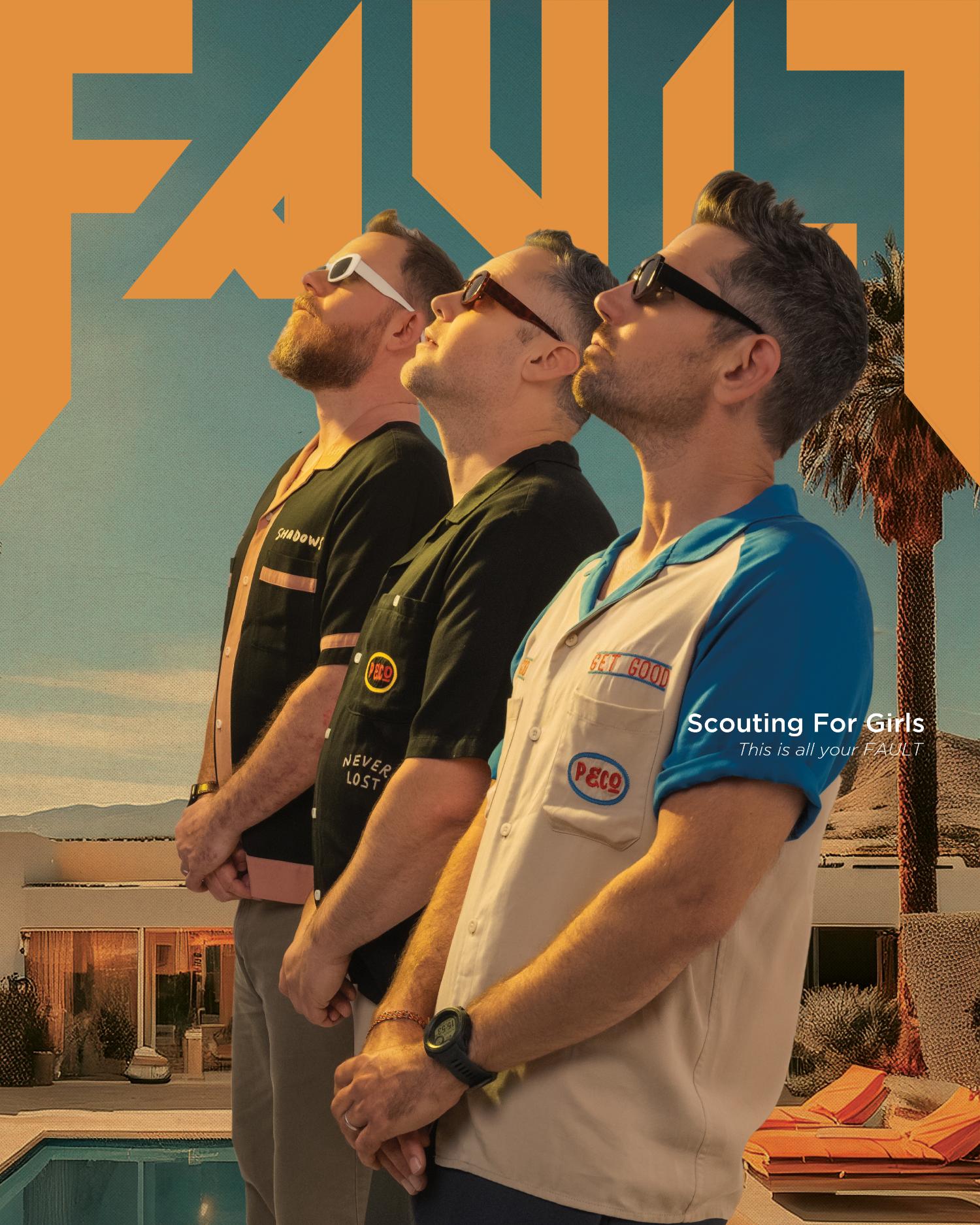
Nearly twenty years on from their breakthrough, Scouting For Girls remain one of British pop’s most quietly enduring success stories. With their new album These Are The Good Days, the trio lean fully into what they’ve always done best: crafting unapologetically joyful, singalong-ready songs that feel both nostalgic and refreshingly present.
We caught up with Scouting For Girls to talk about honesty in songwriting, redefining success, and why sometimes the best songs are the ones you can shout badly in the car.
FAULT Magazine: Was there any significant change to your process this album compared with your previous releases?
Scouting For Girls: Yes and no. It’s still basically the same deeply sophisticated process of sitting at a piano, having a mild existential crisis, and hoping something decent falls out. But I think this time I was a bit less concerned with trying to be clever and a bit more obsessed with trying to be honest. In the early days, you’re often writing to prove yourself. Now I’m more interested in writing songs that actually make people feel something. Preferably joy. Or at the very least, a strong urge to sing badly in the car at the top of their voice.
FAULT Magazine: There’s a strong sense of optimism running through the record. Was that a reaction to where you are as a band now, or something you felt was missing in the current music landscape?
Scouting For Girls: Probably both. The world has felt quite heavy for a while, and I didn’t really feel the need to add to the national mood of doom. There’s enough misery about. You can get that from the news or social media. I wanted to make something that felt hopeful and positive. Something that reminded people life is still beautiful and brilliant, and to focus on those bits when things get messy. And I think as a band, that’s always been our sweet spot really, finding the joy in ordinary life and turning it into a big singalong. I honestly believe my life’s purpose is to bring the most amount of joy as possible to the most amount of people. I am a people pleaser!
FAULT Magazine: Nearly 20 years into your career, how has your perspective on what “the good days” actually are changed since your early releases?
Scouting For Girls: When you’re younger, you think the good days are the big glamorous moments the chart positions, the TV shows, the parties, all that stuff. And some of it is amazing, obviously. I’m not going to pretend getting a number one was like popping to Tesco. But as you get older, you realise the good days are often much smaller and much more important. It’s being with your family. Being in a room with your mates making music. A crowd singing your song back to you. A day where nobody has a disaster and you phone your dad and walk the dog with your kids.
FAULT Magazine: The album ventures from piano-led pop to more rocky vibes. Was that variety of sound intentional, or a more organic reflection of what you were naturally listening to?
Scouting For Girls: A bit of both. We started as teenage wannabe Nirvana and have always had a couple of rock songs on every album ‘Mountains of Navaho’ on album one and ‘1+1’ on album two. They are always fun to smash out live as a surprise. I do love rock but my heart is pure piano indie pop. My two most listened to artists this year were Wunderhorse and Maisie Peters… I’m pretty sure no one else in the world has those two at the top of their list!
FAULT Magazine: With sold-out tours and huge arena shows coming up next February, how does the energy of the audience today compare to when you first started out 20 years back?
Scouting For Girls: It’s bigger now. In the early days it was chaos, which was brilliant. Everyone was young, we were young, nobody really knew what they were doing, least of all us. Now the crowds are still just as up for it, but there’s something more emotional in it as well. People have grown up with these songs. They’ve fallen in love to them, got married to them, got dumped to them, had kids, got mortgages, had nervous breakdowns in garden centres, the full British experience. So when they sing them back now, it means even more. It’s less “here’s a hit single” and more “this song has been following me around for half my life.”
FAULT Magazine: Your then younger fans are now your long-term listeners, but you’re still attracting young teen fans. What would you say it is about your music that it continues to transcend natural age barriers?
Scouting For Girls: I think hopefully it’s because the songs are about things that never really change, love, insecurity, hope, nostalgia, wanting someone to fancy you, pretending you’re fine when you absolutely are not. That stuff works whether you’re 14 or 44. Also, the songs are simple in a good way. You don’t need a PhD to get to the chorus. You can hear it once and be in. That’s always been important to me. I’m not trying to write homework. I’m trying to write something that makes you feel better on the bus.
FAULT Magazine: How important is the live setting and experience when you’re in the writers room? Would you say you ever write or rework songs specifically with the live audience in mind?
Scouting For Girls: Absolutely. Always. I think because we’ve been a live band for so long, it’s impossible not to. Even when I’m writing at home, part of my brain is already in a sweaty room somewhere going, “Will this lift? Will people sing this? Is this the bit where the beers go in the air?” Some songs are clearly private little headphone songs, and that’s lovely. But I do get very excited when I can hear a crowd in the chorus before we’ve even recorded it. That’s usually a good sign. I definitely approach at least half of every record thinking, “How can we win over a festival crowd with this song?” And the other half I’m thinking, “How do I make people cry happy tears?”
FAULT Magazine: Has your relationship with success changed over the years?
Scouting For Girls: Massively. When you start out, success is very external. It’s charts, sales, radio, awards, all the shiny stuff. And again, those things are amazing. I’m still not above enjoying a nice statistic, I look at our number of Spotify listeners and reel count every day! But over time, success becomes much more about longevity and connection. The fact we’re nearly 20 years in, still selling out tours, still making records people care about, and somehow announcing Wembley Arena without being arrested, that feels like real success to me. These days I’m less interested in looking successful and much more interested in actually enjoying my life.
FAULT Magazine: Do you feel more pressure with this album to live up to your catalogue, or more freedom to just enjoy what you’re creating?
Scouting For Girls: More freedom, definitely. No one needs a new Scouting For Girls record, so I have complete freedom in creating the music I want to hear, and still ambition to create something better than we’ve done before. It’s about making something I’m proud of and trying to say something true. Ironically, that often leads to better songs anyway. I still feel we have our biggest and best songs ahead of us!
FAULT Magazine: What is your FAULT?
Scouting For Girls: I’m obsessed with a band called Scouting For Girls.